

Why exact comparisons fail
A traditional chatbot with fixed answers can be tested like any other software: input in, expected text out. A bot built on a language model answers the same question once with “Your appointment is confirmed” and once with “All set, you’re booked.” Both answers are correct, yet a text comparison reports an error.
The result: either the tests fail constantly and get ignored, or they are written so loosely that they no longer check anything.
Check statements, not wording
The solution is to check one level higher. Instead of a fixed sentence, you expect a statement:
| Instead of | Better |
|---|---|
| “Your appointment on May 3 at 10 a.m. is confirmed.” | The bot confirms the appointment on May 3 at 10 a.m. |
| “Please give me your customer number.” | The bot asks for the customer number. |
| “I’m sorry, I can’t give you any information on that.” | The bot declines to give legal advice and names the contact. |
A language model then reads the conversation and decides for each statement: made or not. Good tools provide a reason along with it.
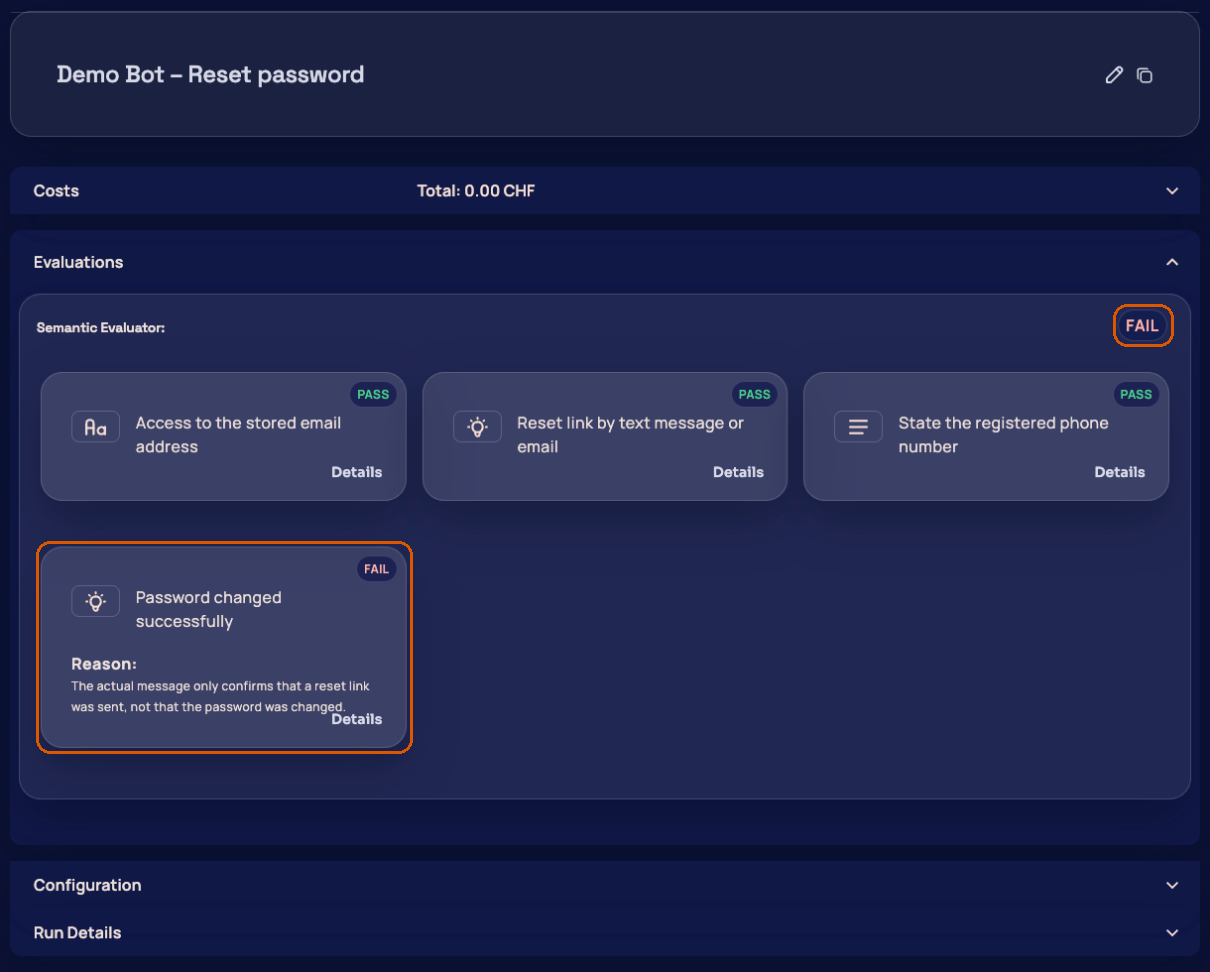
How to write expected statements
- Be concrete. “The bot names the 30-day return period” can be checked, “The bot is helpful” can’t.
- One statement per line. That way the result shows exactly what was missing.
- The outcome, not the path. How many follow-up questions the bot asks usually doesn’t matter. What counts is what is settled at the end.
- Prohibitions too. “The bot does not name a price” is a checkable statement.
Test the whole conversation, not one answer
A single question-and-answer pair says little about a bot that handles a request over several steps. Errors often only arise along the way: the bot forgets a detail from the start, asks twice or gives up after a correction.
That’s why it’s worth running a test that holds the conversation from start to finish. Because the bot answers freely, the other side has to be able to react too: a fixed script no longer fits after the first unexpected follow-up question.
How gentesty does it
In gentesty, you describe a scenario and the expected statements. gentesty holds the conversation with your bot itself and reacts to what the bot says. Afterwards, language models evaluate each statement, by meaning or, where necessary, word for word. Custom evaluators are available from the Business plan.
Continue to chatbot testing or to the article Regression testing for chatbots and voicebots.
Frequently asked questions
Can you test an LLM chatbot automatically at all?
Yes. Instead of comparing the wording, you check whether certain statements were made in the conversation. A language model does that check by judging the answer by its meaning.
Isn't it unreliable when one language model evaluates another?
It is more reliable than it sounds, as long as the expected statements are concrete. What matters is that the evaluation explains its decision, so you can spot wrong verdicts and sharpen the statement.
When is an exact comparison still useful?
For content that must be correct word for word: legal notices, amounts, phone numbers or contract numbers. For everything else, comparing by meaning is the better choice.